
The sad case of Charles Barry and his family
Leave a CommentI have an interest in mental health, having studied Psychology at university and then worked in a number of support roles over the years, so it was very interesting for me to find that my house is built on the site of a former mental hospital. West Yorkshire had a county asylum in Wakefield from the early nineteenth century, but the expanding population outgrew its capabilities, and eventually the South Yorkshire Asylum was opened in Sheffield in 1872.

Photo credit: Sheffield Local Studies Library via PictureSheffield
The surviving records are held at the Sheffield Archives and provide a fascinating insight into our early understanding of mental illness. As I examined the documents, I wondered about the lives of the people who spent time inside the asylum and have begun to research some of them.
One rather unusual case particularly intrigued me, and seems especially fitting as it is the festive season. Charles James Barry was admitted to the asylum from Huddersfield on 13 December 1877 at the age of 21. His stated cause of insanity? Writing a pantomime! I found evidence of his belief in his comic writing abilities from an article in the Yorkshire Evening Post, dated 11 December 1936, which claimed that he had published a comic almanac in 1877. Perhaps this was what prompted him to attempt his pantomime.

Yorkshire Evening Post, 11 December 1936, © Johnson Press plc, via The British Library Board
Charles Barry was the son of James Barry, a Solicitors Managing Clerk from Cornwall, and Ann Barry (nee Chard) from Somerset. Born in Bristol on 7 April 1856, by the age of 14 he too was clerking for a Solicitor. His family moved around a lot, and his siblings were born as far apart as Gloucestershire, Essex, Shropshire and Yorkshire.
By early 1877, Charles had married Sarah Haigh in Huddersfield, and the young couple were expecting their first child. Charles then decided to write a pantomime. Such were the effects of this activity, that he became severely distressed. He was sent to the Asylum for treatment, which at that time most likely included sedation, confinement and occupational therapy. During his rehabilitation, Charles was co-resident with others who had been admitted for issues as diverse as religious mania, delusions, disputes about property, those suffering from head injuries, strokes and epilepsy, as well as others who were struggling with bereavement. There were Coal Miners, Housewives, Teachers, Labourers, Millhands, Weavers, Chemists and Booksellers. Hundreds of men, women and children whose ages ranged from 2 to 92.

Ward for men, a mental hospital in Britain.. Credit: Wellcome Collection. CC BY
His recovery took almost a year, which meant that Charles was never to meet his first born child. His daughter Agnes was born in Huddersfield early in 1878, but sadly died within a couple of months. Charles was finally discharged on 23 September 1878. Once home, he wasted no time getting his life back on track. He and Sarah moved to Grimsby, and went on to have 8 more children, including twin daughters in 1887. Sadly, like Agnes, two more of their children were to die before they reached their first birthday.

His rather extreme reaction to penmanship did not stop Charles from following his love of writing. In 1881 he was working as a Shorthand Writer and living with his growing family in Lincolnshire, but by 1891 he had disappeared. Sarah and their children were recorded on the census in Bolton, but without Charles. He popped up again on the 1911 census, living in Kent with his “wife” Jane Eliza, to whom he had allegedly been married for 8 years, although I couldn’t find any marriage details. Charles was still involved with writing, by then working as a self-employed Letterpress Printer. His abandoned family split up not long after he left. An item in the Bolton Evening News reported that a School Board hearing committed four of his children to the local Industrial School until they reached 16, as they had no adult to care for them.
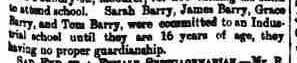
Bolton Evening News, 1 February 1893, © The British Library Board
This leaves so many unanswered questions. What happened to their mother? Their older brother was too young to look after them, and I found him living and working with other families on subsequent census returns. Sister Sarah appeared in 1901 having remained in Lancashire. James, on the other hand, appeared in Shropshire. Did he find work with a friend of his grandparents? Grace had a twin sister, for whom I did not trace a death. Where did she go? Mind you, Grace was originally registered as Mabel, so perhaps her twin’s name was changed too! The other big questions are of course about Charles. What exactly happened at the end of 1877? Did he continue to have mental health problems throughout his life? Perhaps that was a factor in the break up of his marriage. There is still so much more to be discovered about the sad case of Charles Barry and his family.


