
We Shall Remember Them
The approach of the centenary of the ending of the First World War made me think about the members of my own family who fought. Of those who returned, many were scarred forever by their experiences. Still more signed up for an adventure but were never to come home.
My grandfather, Frederick George Watson, fought in the war and survived. He was born in Ashford, Kent on 11 September 1895, the middle child of Frederick and Kate Watson. On 17 May 1915, at the age of 19 years and 8 months, Frederick travelled to Canterbury where he enlisted in the 1st East Kent Regiment (Mounted Rifles) of the Territorial Force. On 13 January 1916 he set sail for Egypt before being transferred to the 10th East Kent (The Buffs). He supported the defence of the Suez Canal, then saw action in Palestine and Gaza, recapturing Jerusalem in December 1917. In April 1918 his regiment then moved to France where he took part in the second Battles of the Somme and the Battles of the Hindenburg Line. Having escaped physically unscathed until this point, he then contracted trench fever before being admitted to hospital suffering the effects of shell gas less than two weeks before the Armistice.
Frederick was demobilized on 26 March 1919 and returned to Ashford where he married his sweetheart, Alice Emily Cooter, had two sons and lived to see the births of his six grandchildren. He served in the Home Guard during the second World War, remaining in Ashford until his death in 1976.

Neither my great-uncle Edgar Collison, nor my husband’s great-uncle, Edgar Cook, were so fortunate. I know little of what happened to either of our Edgars. Unfortunately, many of the First World War soldier’s service records were destroyed in a fire from an incendiary bomb dropped on London during the Second World War. Of those that survived, most were severely damaged by the fire, or from the water used putting out that fire.
Edgar Collison was the son of John and Mary Ann Collison. Born in Eye, Northamptonshire on 26 January 1880, Edgar was the fourth of nine children. He was working as a sawyer in 1901 and still at home with his parents (now living in London) along with two older and four younger siblings. At some point in the next few years he moved to Portsmouth, and when the 1911 census was taken he was working as a skilled labourer at the Gun Wharf, run by the Naval Ordinance Department[1].
Edgar never married. I’m guessing he may have been conscripted in March 1916, along with other able bodied single men between the ages of 19 and 41. He died of wounds on 7 May 1917 in France and is buried at Etaples Military Cemetery. He was Rifleman 393595 in the 1/9th Battalion London Regiment at the time of his death, having served with them from 25 December 1916. His unit took part in the Battle of Arras (the Third Battle of the Scarpe) at Monchy-Le-Preux on 3 May 1917. This was a German defensive victory, with the attack called off by the allies following severe casualties. The War Diary of his unit for 3 May states: “… trenches heavily bombarded Several casualties in all companies” and the following day: “Battalion estimated casualties from May 1st – 100 O[ther] R[an]ks”.
Edgar Cook was the son of Henry and Alice Eliza Cook, born on 5 May 1896 in Islington. He was the fourth of eleven children. The 1911 census describes him as working at the GPO as a messenger, despite his older brothers and father all working on the railways. According to his commemoration at the Commonwealth War Graves Commission, by the time he enlisted he had moved on to be a letter sorter at Mount Pleasant in Clerkenwell.
Private Edgar Cook, then just 20 years old, of the 10th Battalion, Essex Regiment was killed in action on 26 September 1916. One of the Battles of the Somme (the Battle of Thiepval Ridge) took place on this day at Authuille. The battle is described as a British victory, with the 10th Essex one of the lead battalions whose objective was to retake Thiepval village. The advance met heavy resistance, but ultimately succeeded in driving out the German military by the next morning. As Edgar was a Private, again his death elicited no more than a passing reference in his regimental War Diary as one of the 23 “other” ranks who were killed that month.
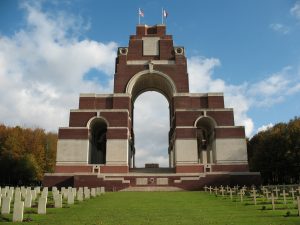
Edgar Cook (Private 43218) has no known grave, and is commemorated at Thiepval Memorial to the Missing of the Somme.

In Flanders fields the poppies blow
Between the crosses, row on row,
That mark our place; and in the sky
The larks, still bravely singing, fly
Scarce heard amid the guns below.
We are the Dead. Short days ago
We lived, felt dawn, saw sunset glow,
Loved and were loved, and now we lie
In Flanders fields.
Take up our quarrel with the foe:
To you from failing hands we throw
The torch; be yours to hold it high.
If ye break faith with us who die
We shall not sleep, though poppies grow
In Flanders fields.
John McRae
3 May 1915
[1] http://www.ataleofonecity.portsmouth.gov.uk/place/gunwharf-quays/


